Beyond the Surface: The Anatomy and Alchemy of True Xuan
Share
In our previous post, we introduced Xuan paper as the "King of Papers." But what happens behind the scenes to make a sheet of paper last a thousand years? Today, we’re looking under the microscope at the fibers and the ancient "alchemy" that gives this paper its soul.
The Biological "Skeleton and Flesh"
The secret to Xuan paper’s durability and beauty lies in a perfect biological marriage. It isn't just "paper"; it’s a structural masterpiece.
-
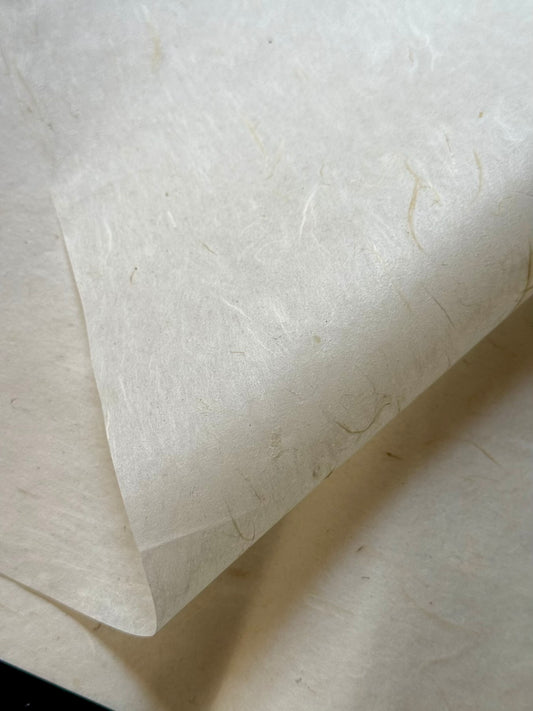
The Skeleton (Blue Sandalwood Bark): The fibers of the Pteroceltis tatarinowii (Blue Sandalwood) are long, slender, and incredibly tough. They provide the "bone" of the paper, allowing it to be rolled, unrolled, and folded for centuries without cracking.
-
The Flesh (Rice Straw): To give the paper its famous absorbency, artisans add local rice straw. These shorter fibers fill the gaps between the sandalwood "bones," creating the perfect surface for ink to bloom.
The "Ink-Bloom" Phenomenon (Moyu)
Why do artists struggle with "rice paper" imitations but thrive with authentic Xuan? It comes down to capillary action.
Because Xuan paper is handmade without harsh chemical binders, the ink doesn't just sit on top. It travels through the fibers. This creates the "Five Colors of Ink," where a single brushstroke can show a spectrum of shades from deep velvet black to a ghostly, translucent grey.
The 108-Step Legacy: A Two-Year Journey
A single sheet of Xuan paper in our shop is the result of nearly two years of patience.
1. Hillside Sun-Bleaching
Unlike modern paper bleached with chlorine, Xuan fibers are spread across limestone hillsides. They are whitened naturally by the sun, rain, and dew. This natural process preserves the fiber's integrity, ensuring the paper never becomes brittle.
2. The Master’s Scoop
The most critical moment is Sheet Forming. An artisan dips a bamboo screen into a vat of fiber-rich water. It requires incredible core strength and rhythm to "scoop" the pulp so that the thickness is consistent to the millimeter.
3. "Jia Xuan": Strength in Layers
If you find standard Xuan too delicate for your style, you need Jia Xuan (夹宣).
-
Double Layer (Er Ceng): Two wet sheets are pressed together during the making process.
-
Triple Layer (San Ceng): Three sheets combined.
-
Why use it? If you practice Xieyi (freehand) painting with heavy water washes, Jia Xuan provides the "body" to handle the moisture without warping or tearing.